
5 Stoic Habits Seneca Swore By (That Still Work in 2025)
Why Stoicism Matters More Than Ever in a Hyperconnected World
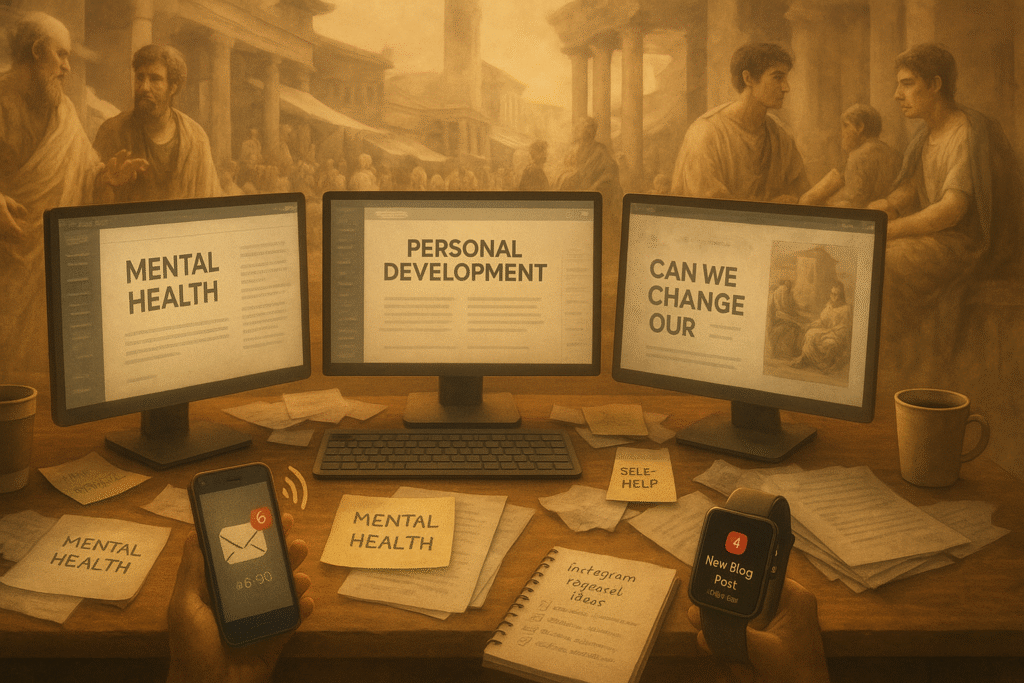
Your smartwatch buzzes with another notification as you swipe through emails on your phone. Meanwhile, your AR glasses flash a reminder about that deadline you’ve already pushed back twice. Across three screens, messages pile up faster than you can address them. It’s Tuesday morning in 2025, and like many young professionals, you’re already experiencing decision fatigue—and you haven’t even finished your coffee.
Despite the 2,000 years between us, Seneca faced similar human challenges. No, he didn’t have Slack notifications or AI-generated task lists, but he navigated the relentless demands of Roman politics, social obligations, and the constant pressure to perform under scrutiny. The tools have changed, but the struggle remains the same: too much to do, too many decisions to make, and too little mental clarity to do it all well.
Seneca wasn’t just a philosopher writing elegant theories from an ivory tower. As a statesman, playwright, and advisor to emperors, he applied Stoic philosophy in the midst of a turbulent life—one that included exile, political intrigue, and ultimately, a forced suicide ordered by Emperor Nero. Through it all, he developed practical habits that kept him centred, productive, and mentally resilient.
At its core, Stoicism isn’t about suppressing emotions or maintaining a stiff upper lip. It’s a practical philosophy designed to help ordinary people face life’s challenges with resilience and inner strength. The Stoics believed that by focusing our energy on what we can control and accepting what we cannot, we gain the mental clarity needed to navigate life’s complexities.
These aren’t just ancient practices—they’re evidence-backed strategies that align with modern psychology. What Seneca intuited about morning routines, reflection, and voluntary discomfort now finds support in research on cognitive behavioural therapy, mindfulness, and resilience training. The wisdom endures because it’s grounded in human nature, which hasn’t changed—even if our technology has.
The five Stoic habits explored in this article form a complete system for mental resilience and personal growth that transcends time. From the Roman Forum to your open-concept office, these practices have helped people maintain clarity, purpose, and inner peace for centuries. Implement even one, and you’ll be drawing from a tradition that has sustained people through far greater challenges than a cluttered inbox or a demanding manager.
Let’s bring Seneca into your morning routine—and reclaim your clarity in a noisy world.
Habit 1: Wake Up Early and Reflect
In an age where many of us reach for our phones before our feet touch the floor, Seneca’s first habit offers a radical alternative. For the Roman philosopher, the early morning hours weren’t for checking notifications or scrolling feeds—they were sacred moments reserved for mental preparation and self-alignment.
Seneca viewed these quiet moments at dawn as uniquely valuable. In his Moral Letters to Lucilius, he writes: “The best time to plan the day is before the day begins. The best time to reflect on life is before external voices cloud your judgment.” This wasn’t just philosophical theory—Seneca practiced this discipline throughout his turbulent career as advisor to emperors and as a man frequently navigating political danger.
“Begin each day by telling yourself: Today I shall be meeting with interference, ingratitude, insolence, disloyalty, ill-will, and selfishness.” (Meditations, attributed to Seneca’s contemporary Marcus Aurelius)
This might sound negative, but this morning mental rehearsal wasn’t about pessimism—it was about mental preparation that allowed Seneca to respond thoughtfully rather than react emotionally to whatever challenges the day might bring.
Modern neuroscience confirms what Seneca intuited: morning reflection literally primes your brain for better decision-making. During sleep, your prefrontal cortex—responsible for executive functions like planning and impulse control—gets a reset. The quiet moments after waking, before exposure to external stimuli, provide an optimal window for setting intentions and mental framing. Research shows that decisions made during this period tend to align more closely with our core values rather than reactive impulses.
A 5-Minute Stoic Morning Reflection
You don’t need to meditate for an hour to benefit from this practice. Here’s a simple 5-minute routine derived from Stoic teachings:
- Minute 1: Gratitude – Identify three specific things you’re grateful for today. Seneca emphasised gratitude as a foundational practice.
- Minute 2: Anticipated Challenges – What difficulties might you face today? Visualise yourself responding with patience and wisdom.
- Minute 3: Values Check – Select one core value (courage, justice, temperance, wisdom) to focus on today.
- Minute 4: Perspective – Remind yourself of your place in the grand scheme of things. As Seneca wrote, “Set aside a certain number of days during which you shall be content with the scantiest and cheapest fare, with rough and coarse clothing, saying to yourself the while, ‘Is this the condition that I feared?'”
- Minute 5: Intention Setting – What one thing, if accomplished today, would make the day worthwhile?
Making It Work for Your Life
Different lifestyles require different approaches:
For busy parents: Even 2 minutes of reflection while the coffee brews can centre your day. Some parents find success waking up 10 minutes before their children to create this space.
For students: Align your reflection with your body’s natural rhythms. If you’re not a morning person, this practice can be adapted to whenever you naturally begin your day—the key is doing it before engaging with external inputs.
For night shift workers: The principle remains the same—create space for reflection at the beginning of your waking hours, whenever they occur.
This habit has powered success across centuries and fields. Tim Ferriss, entrepreneur and author, credits his morning journaling practice with his ability to maintain focus amid countless opportunities. Ancient Roman general Marcus Aurelius practiced morning reflection to maintain perspective during military campaigns. Modern CEOs like Jack Dorsey and Oprah Winfrey similarly guard their morning hours for centring practices before the demands of leadership take over.
What struggles might become easier if you claimed this time for yourself? Perhaps difficult conversations would become more productive. Maybe decisions would align better with your deeper values rather than urgent demands. Your morning reflection might be the difference between a day that happens to you and a day you intentionally shape.
Habit 2: Write Daily to Control Your Mind
In today’s world of fleeting digital communication, Seneca’s second habit feels almost revolutionary: deliberate, thoughtful writing as a tool for mental clarity. Unlike our quick texts and reactive social media posts, Seneca engaged in extensive letter writing—not just to communicate with others, but as a practice for organising and examining his own thoughts.
Seneca wrote hundreds of letters to his friend Lucilius, many of which survive today as the collection “Moral Letters to Lucilius.” These weren’t just casual correspondence; they were carefully crafted explorations of philosophical ideas and personal challenges. For Seneca, the act of writing was a form of thinking made visible—a way to clarify his own understanding and examine his assumptions.
“I am writing to you, Lucilius, as if I were talking to you,” he notes in one letter. But this conversational tone belies the deeper purpose: through writing, Seneca was engaging in a form of self-dialogue that helped him refine his thinking and overcome emotional reactivity.
Modern psychology confirms the power behind this practice. When we write down our thoughts, we externalise them—creating psychological distance that allows us to examine them more objectively. This process, sometimes called cognitive defusion in contemporary therapy, helps us see that our thoughts are not facts but mental events we can observe and evaluate. The physical act of writing engages different neural pathways than merely thinking, activating parts of the brain associated with learning and memory.
Three Writing Exercises Inspired by Seneca
At day’s end, answer three questions Seneca regularly considered:
- What did I do well today?
- Where did I fall short of my values?
- How might I improve tomorrow?
This simple practice creates accountability to yourself and builds self-awareness over time.
The Letter to Yourself
Following Seneca’s model of letter writing, compose a short letter to yourself about a challenge you’re facing. Write as if advising a friend—with wisdom and compassion rather than harsh judgment. This perspective shift often reveals solutions hidden by emotional involvement.
The Adversity Challenge
Write about a current difficulty using these Stoic prompts:
- What aspects of this situation can I control?
- What virtue might this challenge help me develop?
- How might I view this situation in five years?
This exercise transforms obstacles into opportunities for growth—a core Stoic principle.
Modern Tools for Ancient Practices
While Seneca used papyrus and stylus, we have options that make Stoic writing practices more accessible:
- Digital journals like Day One or Stoic journal apps that provide prompts based on ancient philosophy
- Note-taking apps like Notion or Evernote that allow you to create templates for regular reflection
- Voice-to-text tools for those who prefer speaking to typing
- Physical journals with Stoic prompts for those who prefer the tactile experience of pen and paper
The medium matters less than the consistent practice.
Transformation Through Writing
Consider Maria, a young marketing executive who felt constantly triggered by her micromanaging boss. Her initial reaction to criticism was defensive anger that damaged their working relationship.
Before writing practice: After a critical email, Maria immediately fired back a defensive response she later regretted.
After implementing daily writing: When criticism arrived, Maria noted her emotional reaction in her journal, examined the assumptions behind her response, and identified what aspects she could control. The next day, she approached her boss with a measured, solution-focused conversation that improved their dynamic.
This isn’t just an isolated example. Regular writing practice trains the mind to create a pause between stimulus and response—what psychologists call the “response flexibility” that characterises emotional intelligence.
Your Turn
Have you experienced insights through writing that weren’t accessible through just thinking? How has putting thoughts on paper changed your perspective on a challenge? Share your experiences in the comments—your insight might be exactly what another reader needs to hear.
Resources for Deeper Exploration
For those wanting to develop this practice further:
- “The Daily Stoic Journal” by Ryan Holiday provides 366 days of Stoic journaling prompts
- “Meditations” by Marcus Aurelius—essentially the personal journal of a Roman Emperor practicing Stoicism
- “How to Think Like a Roman Emperor” by Donald Robertson explains the psychological mechanisms behind Stoic writing practices
- The Stoa app offers guided Stoic journaling exercises based on original texts
Whether you prefer digital tools or traditional journals, the key is consistency. As Seneca himself wrote, “Each day acquire something that will fortify you against poverty, against death, indeed against other misfortunes as well.” Daily writing is precisely this kind of fortification for the modern mind.
Habit 3: Practice Voluntary Discomfort
In our comfort-optimised world of temperature-controlled environments, on-demand everything, and algorithms that shield us from opposing viewpoints, Seneca’s third habit feels almost heretical: deliberately seek out discomfort.
Seneca—a man of considerable wealth and privilege in ancient Rome—regularly practiced what the Stoics called “voluntary hardship.” Despite access to luxury, he would periodically wear his shabbiest clothes, sleep on a hard pallet, and eat the plainest food. As he explained in a letter to Lucilius:
“Set aside a certain number of days, during which you shall be content with the scantiest and cheapest fare, with coarse and rough dress, saying to yourself the while: ‘Is this the condition that I feared?'”
This wasn’t performative asceticism or self-punishment. Rather, Seneca understood something profound about human psychology: our fear of discomfort often causes more suffering than the discomfort itself. By voluntarily embracing controlled hardship, he inoculated himself against anxiety about potential future losses and built confidence in his ability to handle whatever life might throw his way.
Modern psychology distinguishes between harmful chronic stress (distress) and beneficial challenge stress (eustress). While chronic, uncontrolled stress damages health, controlled exposure to manageable stressors—what scientists call “Hormetic stress”—actually builds mental and physical resilience. This is the principle behind exercise: temporary stress on muscles leads to adaptation and growth. The same applies to our mental fortitude.
The 30-Day Progressive Discomfort Challenge
Building this Stoic habit doesn’t mean immediate asceticism. Start small and build gradually:
Week 1: Physical Discomfort
- Day 1-2: End your shower with 30 seconds of cold water
- Day 3-5: Take a 5-minute walk regardless of weather
- Day 6-7: Skip one meal or practice 16-hour intermittent fasting
Week 2: Convenience Discomfort
- Day 8-10: Take the stairs instead of elevators
- Day 11-12: Wait in the longest checkout line deliberately
- Day 13-14: Disable notifications on your devices for increasing periods
Week 3: Social Discomfort
- Day 15-17: Make a phone call instead of texting for something important
- Day 18-19: Have a conversation with someone whose views differ from yours
- Day 20-21: Ask for help with something you’d normally struggle through alone
Week 4: Deeper Challenges
- Day 22-24: Sleep on the floor one night
- Day 25-27: Fast for 24 hours (if medically appropriate)
- Day 28-30: Digital detox for 24 hours (no screens)
These graduated challenges help build what psychologists call “distress tolerance”—the ability to remain functional and clear-headed during difficult situations.
Modern Applications for Different Lifestyles
Different audiences can adapt this practice to their specific needs:
For young professionals: Tackle difficult conversations you’ve been avoiding, or pitch your ideas first in meetings even when it feels uncomfortable.
For students: Study in less-than-ideal environments occasionally to build focus muscles that don’t depend on perfect conditions.
For parents: Try handling childcare challenges without immediately reaching for the digital babysitter.
For those with health considerations: Consult healthcare providers about appropriate forms of Hormetic stress, such as temperature variation or mild caloric restriction.
Success Through Discomfort
This practice has powered remarkable achievements across diverse fields:
Wim Hof, known as “The Iceman,” used controlled cold exposure to develop extraordinary physiological control, demonstrating how voluntary discomfort can unlock hidden human potential.
Entrepreneur Jesse Itzler invited a Navy SEAL to live with him for a month specifically to push him beyond his comfort zone, an experience that transformed his approach to business challenges.
Mindfulness teacher Tara Brach regularly incorporates “leaning into difficulty” in her meditation practices, helping practitioners develop what she calls “radical acceptance” of uncomfortable experiences.
Research published in the Journal of Personality and Social Psychology found that individuals who regularly practice forms of voluntary discomfort show significantly higher levels of emotional regulation when facing real-life challenges. A 2023 study in the journal Frontiers in Psychology demonstrated that controlled exposure to manageable stressors increased participants’ perceived self-efficacy and resilience scores by an average of 32% over eight weeks.
These findings align perfectly with what Seneca intuited two millennia ago: comfort is a poor teacher, while managed discomfort builds wisdom.
Your Discomfort Journey
How might embracing small discomforts prepare you for life’s inevitable larger challenges? Perhaps the confidence gained from handling physical discomfort will translate to greater courage in your career. Maybe practice with delayed gratification will strengthen your financial discipline. The willingness to engage with opposing viewpoints might transform conflict into connection.
The beauty of this practice is that the benefits transcend the specific discomforts you choose. Each small victory over comfort-seeking builds what Seneca called “the invincible summer”—an inner strength that remains regardless of external circumstances.
What small discomfort might you voluntarily embrace today as your first step toward greater resilience?
Habit 4: Detach from What You Can't Control
In our hyper-connected world where we’re constantly bombarded with global crises, market fluctuations, and other people’s opinions, Seneca’s fourth habit offers perhaps the most liberating mental shift possible: focus exclusively on what you can control, and release attachment to everything else.
This concept—the Stoic dichotomy of control—forms the cornerstone of applying Stoicism in daily life. It’s elegantly simple yet profoundly transformative: some things are within our power, and others are not. Mixing these categories creates unnecessary suffering.
Seneca expressed this principle clearly in his essay “On Tranquility of Mind”:
“There are things which are within our power, and there are things which are beyond our power. Within our power are opinion, aim, desire, aversion, and, in one word, whatever affairs are our own. Beyond our power are body, property, reputation, command, and, in one word, whatever are not properly our own.”
This distinction isn’t about passive resignation but strategic focus. Seneca advised his friend Lucilius: “The chief task in life is simply this: to identify and separate matters so that I can say clearly to myself which are externals not under my control, and which have to do with the choices I actually control.”
The Modern Circle of Control Exercise
This ancient wisdom translates perfectly into a practical modern exercise:
- Draw three concentric circles on paper (or download our worksheet below)
- Label the innermost circle “Complete Control” (your thoughts, responses, actions)
- Label the middle circle “Some Influence” (your relationships, work projects, some health outcomes)
- Label the outer circle “No Control” (the weather, other people’s opinions, the economy)
- When facing a stressful situation, map its elements onto this diagram
- Consciously redirect energy from the outer circle to the inner circles
This simple exercise creates immediate clarity and reduces anxiety by focusing your attention where it can be most effective.
Real-World Applications
In the workplace: Sarah, a project manager, was constantly stressed about potential client reactions to deliverables. By applying the dichotomy of control, she identified that while she couldn’t control client personalities or marketplace pressures, she could control her team’s preparation, the clarity of their communication, and her own response to feedback. This mental shift allowed her to sleep better and lead more effectively.
In relationships: Marcus struggled with his partner’s occasional moodiness, often taking it personally and becoming defensive. After practicing the Circle of Control, he recognised that while he couldn’t control his partner’s emotions, he could control his supportive presence, his communication style, and when to give space. Their relationship improved dramatically.
With health challenges: Elena received a concerning diagnosis that sent her into an anxiety spiral. Using the Stoic framework, she separated what she couldn’t control (certain biological factors) from what she could (treatment adherence, lifestyle choices, mental attitude). This clarity allowed her to channel her energy productively rather than wasting it on what-ifs.
Transforming Anxiety into Action
What makes this habit so powerful is how it converts anxious rumination into productive focus. Neuroscience research shows that the perception of control activates different neural pathways than anxiety about uncontrollables. When we clearly separate these categories, the brain can more effectively engage problem-solving circuits rather than threat-response mechanisms.
The results can be life-changing:
- Reduced anxiety and worry
- Improved decision-making under pressure
- Greater emotional stability during uncertainty
- More effective use of limited time and energy
- Increased sense of personal agency
As Ryan Holiday, a modern Stoic author, notes: “The single most important practice in Stoic philosophy is differentiating between what we can change and what we can’t.” This isn’t merely philosophical theory—it’s practical psychology that works as well in 2025 as it did in ancient Rome.
Your Control Challenges
- Other people’s opinions of me
- Political/world events
- Family members’ choices
- Work outcomes
- Future uncertainties
- Health concerns
- Past regrets
Explore Further
For those wanting to dive deeper into this transformative concept:
- “The Enchiridion” by Epictetus—the classic manual on the dichotomy of control
- “A Guide to the Good Life” by William Irvine explores this concept in depth
- The Daily Stoic podcast episode “The Dichotomy of Control: The Stoic Secret to Peace and Power”
- “Stoicism and the Art of Happiness” by Donald Robertson examines the psychological mechanisms behind this principle
By practicing this habit of mental sorting—consistently redirecting attention from what you cannot control to what you can—you’ll develop what Seneca called “tranquility of mind,” even in the most challenging circumstances.
Habit 5: Read More, React Less
In an age where the average person spends hours each day consuming snippets, headlines, and hot takes, Seneca’s final habit feels like a radical act of resistance: engage in deep, deliberate reading as a pathway to wisdom.
Seneca was an avid reader who viewed books not as passive entertainment but as active conversations with the greatest minds across time and space. In his letters, he describes reading as a form of intellectual nourishment that shapes the mind:
“We should hunt out the helpful pieces of teaching, and the spirited and noble-minded sayings which are capable of immediate practical application—not far-fetched or archaic expressions or extravagant metaphors and figures of speech—and learn them so well that words become works.”
This wasn’t reading for information accumulation or status signalling—it was reading as transformation. Seneca carefully selected texts, extracted their wisdom, and incorporated their insights into his daily life and thought processes.
The contrast with our modern information diet couldn’t be starker. Today we consume information in ways that trigger dopamine without building wisdom: skimming headlines, bouncing between notifications, and absorbing fragments without synthesis. The average American checks their phone 96 times daily—roughly once every 10 minutes—creating a state of perpetual reactivity rather than thoughtful response.
Deep reading operates differently. When we engage with substantive texts—particularly philosophy, literature, and history—we activate neural pathways associated with empathy, critical thinking, and moral reasoning. MRI studies show that narrative reading activates brain regions involved in social cognition and perspective-taking. In other words, good books don’t just inform us—they form us.
Building a Strategic Reading Habit
Even with busy modern schedules, you can implement this Stoic habit:
1. Time-Block for Deep Reading
- Start with just 15-20 minutes daily (the time you might otherwise spend on social media)
- Create a dedicated reading environment free from digital distractions
- Consider the “5 Pages a Day” technique—a manageable commitment that adds up to 15+ books yearly
2. Practice Slow Reading
- Underline key passages
- Write marginalia questions and insights
- Pause to reflect on how the text applies to your life
- Consider keeping a commonplace book of extracted wisdom (a practice Seneca himself followed)
3. Select Quality Over Quantity
- Choose texts that have stood the test of time
- Read primary sources rather than just summaries
- Balance ancient wisdom with contemporary perspectives
- Re-read important books rather than constantly seeking novelty
Curated Reading List for Different Stoic Beginners
For Young Professionals:
- “The Daily Stoic” by Ryan Holiday (bite-sized daily readings for busy schedules)
- “A Guide to the Good Life” by William Irvine (practical modern applications)
- “Ego Is the Enemy” by Ryan Holiday (Stoic principles for career advancement)
For Mental Health Advocates:
- “How to Think Like a Roman Emperor” by Donald Robertson (Stoicism and cognitive therapy)
- “The Obstacle Is the Way” by Ryan Holiday (turning adversity into advantage)
- “The Art of Living” by Sharon Lebell (accessible adaptations of Epictetus)
For Students:
- “Letters from a Stoic” (selected letters) by Seneca (accessible original texts)
- “The Little Book of Stoicism” by Jonas Salzgeber (concise overview)
- “Meditations: The Annotated Edition” by Marcus Aurelius (with helpful context)
For Philosophy Enthusiasts:
- “Discourses and Selected Writings” by Epictetus (core Stoic teachings)
- “The Stoic Life” by Tad Brennan (academic but readable)
- “Stoicism and Emotion” by Margaret Graver (deeper philosophical analysis)
Transformation Through Reading
Consider James, a marketing executive facing burnout and career dissatisfaction. His social media feeds and news consumption reinforced his anxiety without offering solutions. After adopting Seneca’s reading habit—specifically focusing on Stoic texts for 20 minutes each morning—he gradually shifted from reactivity to response.
Within three months, James reported making decisions from principle rather than pressure, viewing workplace challenges as opportunities for virtue rather than sources of stress, and feeling a sense of agency that had previously eluded him. His career trajectory didn’t immediately change, but his experience of it transformed completely.
Or take Maya, a graduate student overwhelmed by academic pressure. By replacing her habit of checking news and social media before bed with reading selections from Marcus Aurelius, she improved both her sleep quality and her perspective on academic setbacks. The ancient emperor’s words—”You have power over your mind, not outside events. Realise this, and you will find strength”—became a touchstone that changed her relationship with academic pressure.
These aren’t isolated examples. A 2019 study in the journal Social Science & Medicine found that reading literary fiction for just 30 minutes per day was associated with reduced stress hormones and improved wellbeing comparable to meditation. As Seneca intuited, good reading changes the reader.
Advanced Resources for the Philosophically Curious
For those wanting to explore Stoic original texts more deeply:
- The complete “Letters from a Stoic” by Seneca (Oxford World’s Classics edition includes helpful notes)
- “Stoic Six Pack” (collection of complete Stoic texts with modern translations)
- Pierre Hadot’s “Philosophy as a Way of Life” for scholarly context on ancient philosophical practices
- The Internet Encyclopedia of Philosophy’s extensive entries on Stoicism and its key figures
In a world optimised for distraction and reactivity, deliberate reading may be the most countercultural habit you can adopt. As Seneca wrote, “The primary indication, to my thinking, of a well-ordered mind is a man’s ability to remain in one place and linger in his own company.” Deep reading cultivates precisely this capacity—the ability to think clearly, independently, and with perspective.
Which book will you start with?
Stoicism as a System for Modern Resilience
These five Stoic habits—morning reflection, daily writing, voluntary discomfort, focusing on what you can control, and deliberate reading—form not just isolated practices but an integrated framework for living well. Together, they create a system of mental resilience that operates on multiple levels: they prepare your mind at day’s beginning, sharpen your thinking through writing, build your tolerance for discomfort, direct your attention effectively, and continuously expand your wisdom through thoughtful reading.
What makes these practices particularly powerful is their compound effect over time. Just as consistent physical exercise gradually transforms your body, these mental exercises gradually transform your mind. The person who practices morning reflection for a week might notice slightly better focus; the person who practices for a year develops a fundamentally different relationship with their thoughts. The initial benefits are subtle, but the long-term transformation can be profound.
Seneca faced exile, political turmoil, and personal loss—yet his philosophy enabled him to find tranquility amid chaos. His life wasn’t perfect or painless, but his mental framework gave him tools to navigate both success and setback with equanimity. Our challenges may look different from those of ancient Rome, but our human need for resilience remains fundamentally the same.
These ancient practices address distinctly modern problems with surprising precision. Morning reflection counteracts digital distraction. Writing creates the mental space our notification-filled lives desperately need. Voluntary discomfort builds resilience in our convenience-optimised world. The dichotomy of control offers sanity in an age of information overload and global awareness. Deep reading provides an antidote to our culture of shallow consumption and reactivity.
The timelessness of these practices speaks to their connection with fundamental human psychology. They’ve worked for centuries because they align with how our minds actually function—not with passing trends or quick fixes.
Which of these five habits resonated most deeply with you? Perhaps the one that addresses your greatest current challenge, or the one that seems most immediately implementable in your life. Share in the comments which practice you plan to adopt first and why—your insight might be exactly what another reader needs to hear.
If you’re inspired to continue your Stoic journey, numerous resources can support your exploration:
- For structured learning: The Stoa online course “Practical Stoicism” offers an 8-week guided implementation of these principles
- For community: The Modern Stoicism forum connects practitioners worldwide
- For daily practice: The Stoic app provides prompts and tracking for Stoic habits
- For deeper reading: “How to Be a Stoic” by Massimo Pigliucci offers an accessible modern introduction
Remember that Stoicism was never intended as an academic exercise—it was always a practical philosophy meant to be lived. As Seneca himself wrote, “Philosophy teaches us to act, not to speak.” The true test of these ideas is not how well you understand them intellectually, but how effectively they help you navigate life’s inevitable challenges.
By incorporating even one of these habits into your daily routine, you’re not just adopting an ancient practice—you’re reclaiming your mental sovereignty in a world designed to fragment your attention and reactivity. You’re positioning yourself to face life’s challenges not with anxiety or resignation, but with the quiet confidence that comes from knowing you have the internal resources to respond wisely, regardless of external circumstances.
That capacity—to remain centred in your values and agency amid life’s inevitable storms—may be the most valuable skill you can develop in our rapidly changing world.
Ready to bring Stoic wisdom into your daily life?
Join the Conversation
Which of these habits will you try first, and why? Share your thoughts in the comments below! Your perspective might inspire others, and you’ll connect with fellow traveler’s on the Stoic path.
Resources for Further Study of Stoicism
Beginner-Friendly Books:
- “The Daily Stoic” by Ryan Holiday and Stephen Hanselman
- “How to Think Like a Roman Emperor” by Donald Robertson
- “A Guide to the Good Life” by William Irvine
Online Courses:
- [Modern Stoicism’s “Stoic Week” Course] – Free annual guided practice
- [The Daily Stoic’s “Stoicism 101”] – Comprehensive video introduction
- [College of Stoic Philosophers] – More in-depth study programs
Communities:
- [The Stoic Fellowship] – Find local Stoic groups worldwide
- [r/Stoicism] – Active Reddit community with regular discussions
- [The Daily Stoic Facebook Group] – Casual community for daily practice
Remember: Stoicism isn’t about perfection—it’s about consistent practice. Even implementing one small habit can begin a transformation in how you face life’s challenges. As Seneca wrote, “Luck is what happens when preparation meets opportunity.” These practices are your preparation for whatever opportunities—or challenges—life brings your way.